Remote Setting of European Flat Oyster on Rock

TRESPO explored how remote setting can help scale up oyster reef restoration in offshore environments. Instead of placing adult oysters by hand, this project tested whether European flat oyster larvae (Ostrea edulis) can successfully settle on limestone rock in a container-based system and survive handling during deployment. 

Rock is a natural material, stable, widely used in offshore construction, and suitable for dynamic North Sea conditions. If spat-on-rock can be produced and deployed efficiently, it offers a realistic pathway for large-scale reef development within wind farms and restoration areas. 

The objective of TRESPO was to develop and test a scalable spat-on-rock remote setting technique and to assess how different deployment methods affect survival during handling and placement. 

Photo by Wouter van Broekhoven.

June - November 2025

Project dates

Port of Rotterdam; NIOZ Yerseke; Voordelta (VD05)

Location

Van Oord, Stichting Zeeschelp, ARK Rewilding Nederland

Project lead and partners

European flat oyster (Ostrea edulis)

Target species

  • Stand-alone structures

Methods

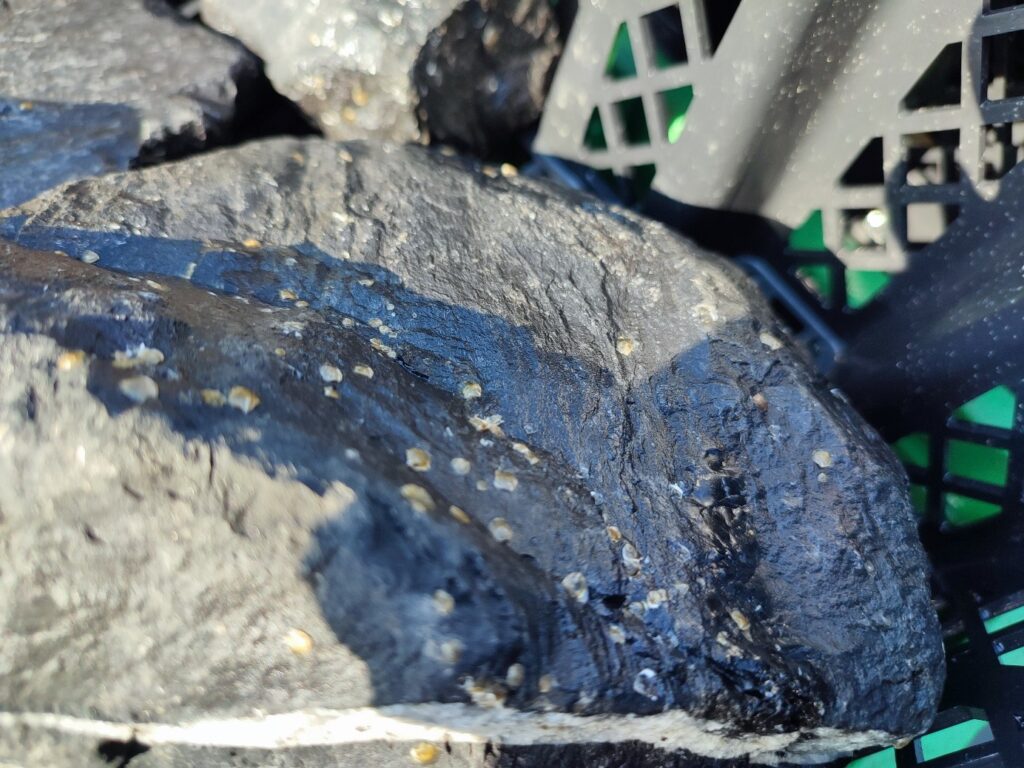
TRESPO developed a modular remote setting facility based on a 20-foot shipping container. Competent oyster larvae were introduced into the system and allowed to settle on limestone rocks. The rocks with settled juveniles (spat-on-rock) were then prepared for deployment. 


Two outplacement approaches were tested and compared. The first used tipping buckets filled with limestone rock. The second used a special rock bag than can be opened, loaded with rock. A controlled drop test in the Oosterschelde simulated offshore handling by dropping the rocks from height during high tide, followed by retrieval at low tide after which spat density was measured and compared to reference samples. 

Photo by Wouter van Broekhoven.


Spat were counted visually to determine spat density. The test focused specifically on loss caused by mechanical handling. 


The project combined marine engineering, hatchery production, logistics, and ecological monitoring.  

Results

Remote setting on rock proved technically feasible. From millions of larvae introduced, an estimated 480,000 spat were visible on the rocks after the settlement and growout period, after 27 days. 


The drop test showed clear differences between deployment methods. Estimated loses were ~25% for the tipping buckets and ~69% for rock bags under the specific test conditions, though these reflect worst-case conditions. Extreme heat during the test (on what would turn out to be the hottest day of the year) likely increased stress and mortality.

Some test conditions like overly-settled reference rocks also skewed results.


The test also took a deliberate worst-case approach by dropping the rocks from a height of 3 m above the water surface. For the rock bag in particular, much abrasion was observed upon release likely leading to massive loss of oyster spat. Finally, the rock bag needed to be hoisted onto the ground before deployment for unfastening, which was the result of requiring an oversized rock bag, also leading to abrasion and losses. Both issues are already addressed in the RESO project by releasing rocks below the water line and by the novel availability of appropriately sized openable rock bags. 


The results confirm that spat-on-rock production and installation are feasible. Deployment method and handling influenced survival, with clear pathways for improvement already identified and implemented. 

Tips and tricks

  • Remote setting of spat-on-rock is technically feasible and suitable for scaling oyster restoration in offshore environments. 
  • Deployment method strongly influences survival; minimizing abrasion and avoiding drops from height are likely to significantly reduce loss. 
  • Reliable power supply, seawater access, and close monitoring during the first settlement days are essential for success. 
  • Live algae feeding requires substantial logistics; automation and sensor-based monitoring can improve efficiency and reduce risks. 
  • Offshore application requires further optimization of deployment tools (e.g., certified tipping systems or improved rock bag handling). 

Partners

Products used on this project

Oyster shells

Oysters are beneficial to the sea, even beyond their lifespan. Empty oyster shells are an all-natural material for marine life to settle.

Scour and cable protection

Let's talk

Would you like to know more about the project? Send us an e-mail.

wouter.vanbroekhoven@vanoord.com