The SUBFRAME project successfully delivered a Python-based stability assessment tool for underwater structures deployed on the seabed. The calculator combines hydrodynamic loading calculations, wave and current modelling, and stability analyses into a single workflow, enabling rapid evaluation of alternative designs during the early stages of project development.
Comparison with existing WaterProof stability assessments showed that SUBFRAME generally produces results within approximately 20% of detailed engineering calculations. The closest agreement was found for relatively simple and closed structures, while larger differences were observed for more complex and open-frame designs. Despite these differences, the tool proved suitable for providing reliable order-of-magnitude estimates and identifying potential stability risks during preliminary design phases.
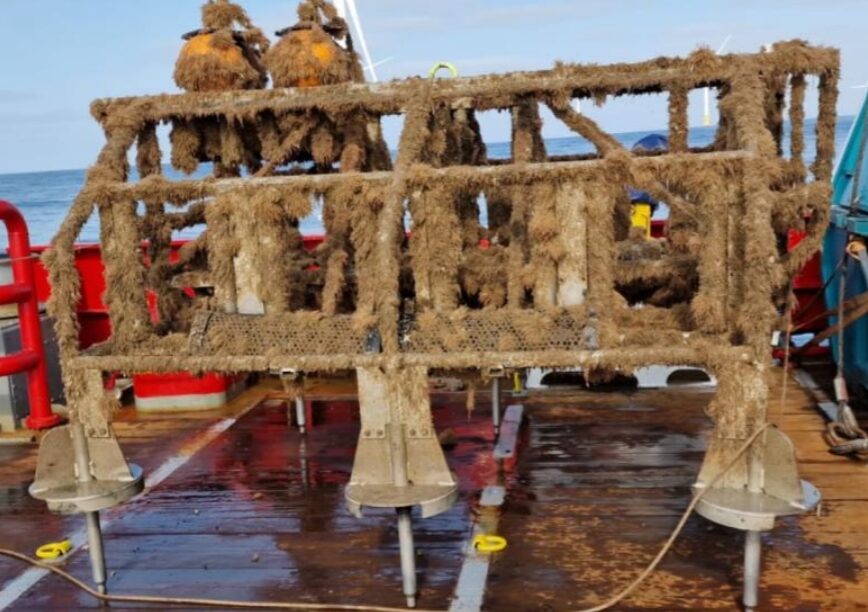
The methodology was evaluated using three representative case studies: an oyster spat collector, an ARC Marine artificial reef structure and the MIXLander monitoring frame. Results demonstrated that the approach can be applied to a wide range of underwater structures used for ecological restoration and environmental monitoring. The analysis also highlighted the importance of accurate geometry information, centre-of-gravity calculations and mesh quality when performing stability assessments.
Overall, the project demonstrated that SUBFRAME can support more efficient design iterations and improve the accessibility of stability assessments for nature-enhancing structures. The study concludes that the tool provides a practical first step towards a validated and widely applicable design platform that can support the safe deployment and scaling-up of artificial reefs, oyster restoration structures and monitoring equipment in offshore wind farms.
Download full report:
Project SUBFRAME final report