Reef Sound Loudspeaker for Oyster Settlement

Healthy oyster reefs produce a distinct underwater soundscape. The crackling and clicking of shrimp, fish and other reef organisms can serve as a natural signal for larvae searching for suitable habitat. International research suggests that oyster larvae respond to these acoustic cues. Within the Nature Regeneration North Sea program, this pilot project tested whether replaying recorded North Sea reef sound offshore could help stimulate oyster settlement and support reef recovery. 

Flat oyster reefs once covered large parts of the Dutch North Sea but have disappeared due to overfishing, habitat degradation and disease. Although restoration efforts are ongoing, larval settlement remains a key bottleneck. The objective of this project was therefore twofold: to develop and validate a prototype offshore underwater loudspeaker that can operate under North Sea conditions, and to assess whether replayed reef sound increases oyster settlement compared to a silent reference location. 
 

This project is funded by Nature Regeneration North Sea, a public–private partnership between The Rich North Sea, Ecoshape, and the Ministry of Agriculture, Fisheries, Food Security and Nature. This alliance of government, industry, and NGOs works toward a resilient and healthy North Sea by restoring biodiversity and thereby creating space for sustainable use.


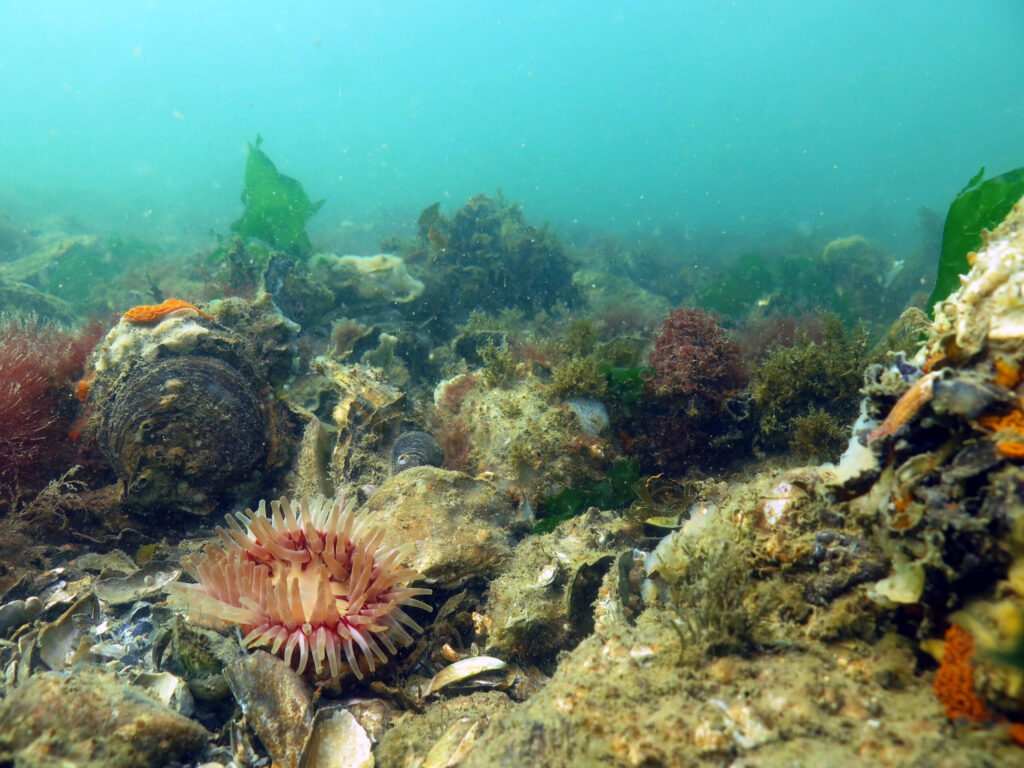
Photo by Floor Driessen, Waardenburg Ecology.
June - September 2025

Project dates

Voordelta, Dutch North Sea

Location

Waardenburg Ecology, Van Oord, WaterProof B.V., Nature Regeneration North Sea

Project lead and partners

European flat oyster and Pacific oyster

Target species

Methods

A prototype underwater loudspeaker system was developed and mounted on a stable offshore frame. The system replayed recorded reef sound from a natural oyster reef during the oyster settlement season and functioned autonomously for two months. Hydrophone measurements confirmed continuous playback at sound levels comparable to natural reef recordings, with an effective range of approximately 30 meters.


To test ecological effects, two locations in the Voordelta were compared: one with reef sound and one silent reference location 72 meters away. At both sites, identical settlement substrates were installed, including oyster shells and roof tiles coated with reef paste. After two months, substrates were retrieved and analyzed for oyster settlement, mussel settlement and coverage by other fouling species. 

Results

Technically, the prototype performed well. It operated continuously under North Sea conditions without battery replacement and successfully reproduced reef sound throughout the settlement season.


Ecologically, the results differed from expectations. Significantly more oysters settled at the reference location than at the sound location. Mussel settlement was higher at the sound location, while fouling species coverage did not differ significantly between sites. Oyster settlement was higher on reef paste than on loose shells. This first field test shows that offshore reef sound playback is feasible, but that sound alone did not stimulate targeted flat oyster settlement under these shallow coastal conditions. 

Tips and tricks

  • Use multiple replicated speaker systems to reduce location effects and strengthen statistical power. 
  • Test at deeper offshore locations (>15m), where competition from mussels and fouling species may be lower. 
  • Combine sound experiments with active oyster restoration sites where larvae are locally produced. 
  • Calibrate acoustic filters at the exact deployment location to improve sound matching. 
  • Standardize substrate surface area to allow better density comparisons. 
  • Monitor larval availability to separate sound effects from larval supply limitations. 
  • Consider background shipping noise, as anthropogenic sound may mask reef sound signals. 
  • Explore broader reef attraction effects, not only species-specific flat oyster settlement. 

Partners

Let's talk

Would you like to get involved in nature enhancement or do you want to connect with our ecologists? Send us an e-mail.

k.didderen@waardenburg.eco