The Lauwersmeerdijk Reef

The Lauwersmeerdijk reef project is a flagship example of how marine construction can be reimagined as a driver of ecological uplift. Launched in 2021 in collaboration with Waterschap Noorderzijlvest, Rijkswaterstaat, and the Waddenfonds, and implemented by the Waddenkwartier consortium (GMB & Heijmans), the pilot sought to test whether artificial reef modules could foster new habitats and boost biodiversity in the delicate Wadden Sea ecosystem.  

From the outset, scientists from Van Hall Larenstein University of Applied Sciences and the University of Groningen led ecological monitoring to observe species colonization, habitat formation, and ecosystem interactions. Over several years, the reefs demonstrated a strong biological performance, attracting shellfish, algae, fish, and a diverse suite of marine life.  

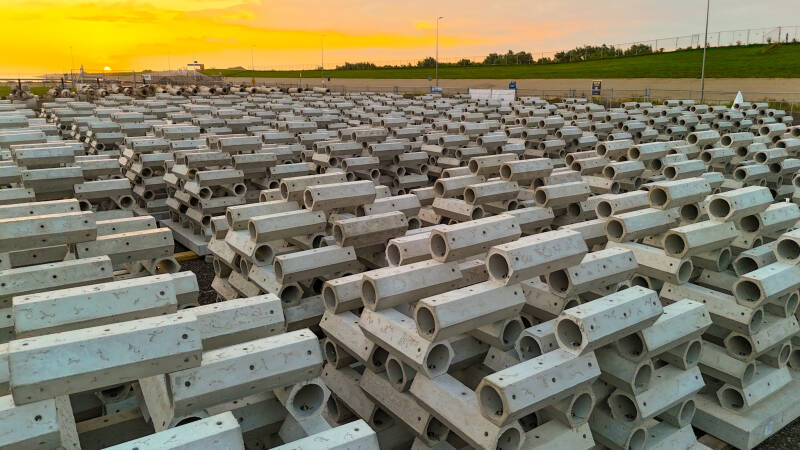
Encouraged by these results, the project has expanded in 2025, installing 100 MOSES reef plates, each containing 56 MOSES blocks, amounting to 5,600 in total. These modular units build on the original pilot’s design philosophy, combining engineered infrastructure with ecological ambition. 
2021-ongoing

Project dates

Lauwersmeerdijk, the Netherlands

Location

ReefSystems, Waterschap Noorderzijlvest, Rijkswaterstaat, the Waddenfonds, University of Groningen, Van Hall Larenstein

Project lead and partners

Mussels, oysters, fish, crustaceans, algae

Target species

  • Stand-alone structures

Methods

MOSES is a modular artificial reef technology developed by ReefSystems to enhance marine biodiversity and ecological performance in coastal and offshore environments. The system consists of interlocking concrete units, known as MOSES blocks, mounted on reef plates that can be adapted to different seabed conditions and project goals. Each block is designed for ecological functionality, with varied textures, cavities, and surface roughness that stimulate the settlement of oysters, mussels, seaweeds, and other marine organisms.  


The structures are produced from recycled concrete aggregates under the Urban Mine principle, resulting in roughly 67% lower CO₂ emissions than conventional materials. The geometry and porosity of the blocks promote marine growth while ensuring long-term stability under tidal and wave forces. Situated at the foot of the Lauwersmeerdijk and the Wadden Sea, the reef enhances biodiversity and ecosystem connectivity by providing complex habitats for shellfish, seaweeds, crustaceans, and fish.  


Monitoring included annual reef retrievals for direct study. Techniques such as scrape sampling, 3D scanning, and collection of sessile organisms document colonization and species diversity, while fish traps record the presence of mobile fauna. 

Results

The pilot phase of the Lauwersmeerdijk Reef (2021–2024) demonstrated the strong ecological performance and durability of the MOSES reefs. The research partners from the University of Groningen and Van Hall Larenstein tested how modular reef structures could enhance biodiversity in the Wadden Sea.


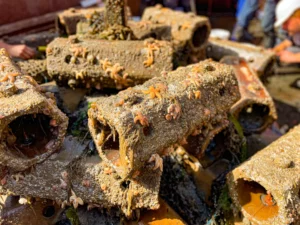
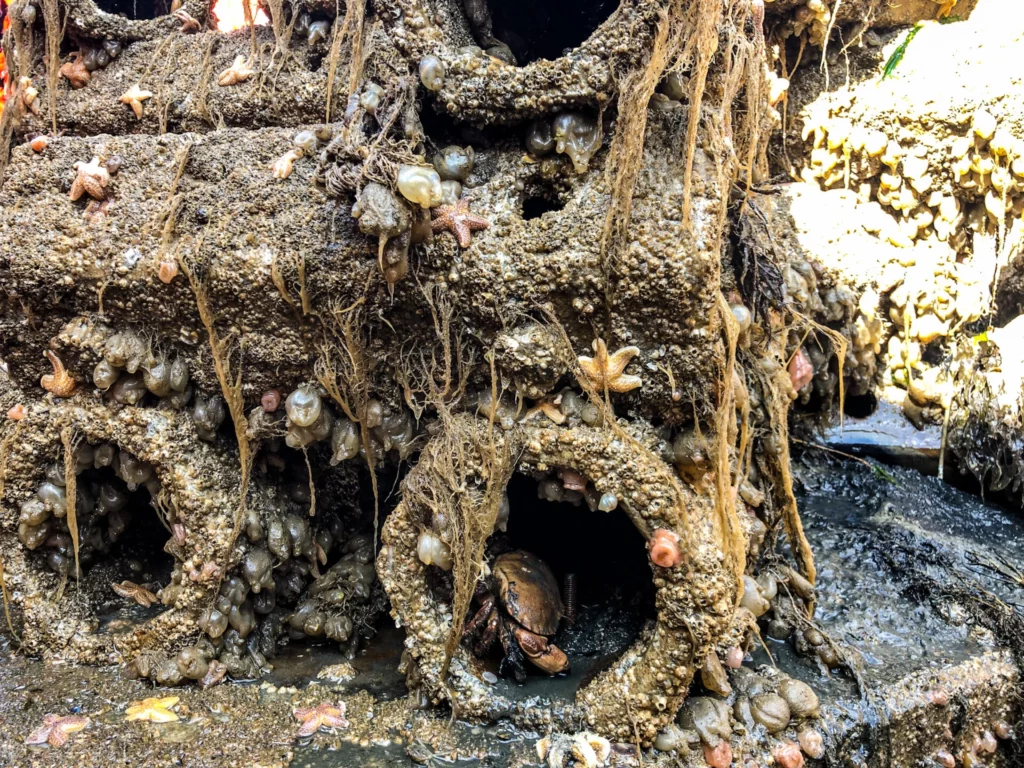
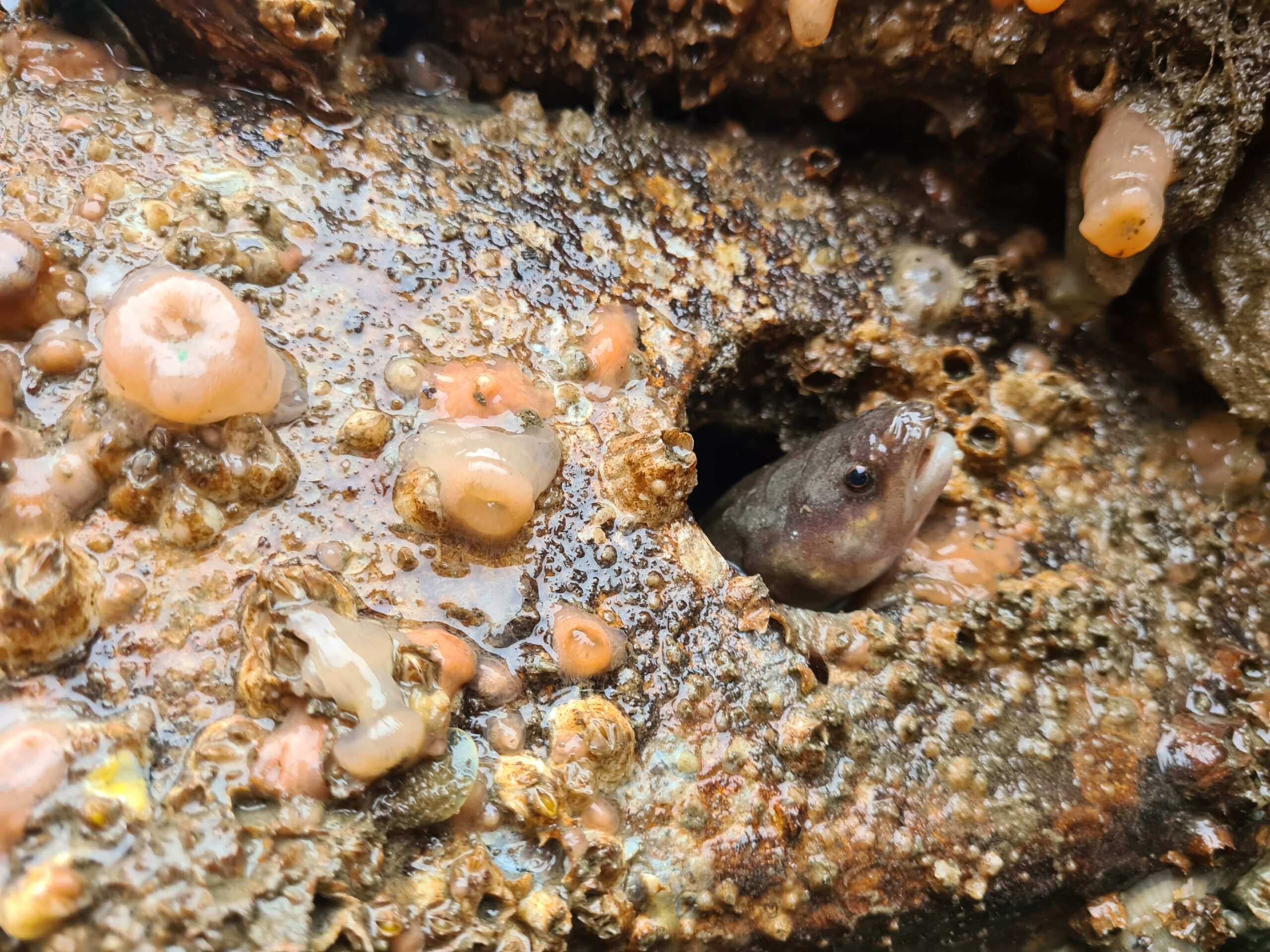
Within one year after installation, the MOSES reefs plates showed rapid colonization by mussels, oysters, barnacles, seaweeds, and tunicates, forming dense living communities that increased habitat complexity and improved ecological conditions along the dike. These assemblages provided shelter and feeding grounds for invertebrates and fish, transforming a previously uniform environment into a thriving underwater ecosystem. Annual monitoring results showed a consistent increase in species richness and biomass over time, confirming the reef’s capacity to support a diverse and productive ecosystem. 


All MOSES reef structures remained structurally stable and sound throughout the entire pilot phase, showing no displacement or degradation, despite exposure to strong tidal currents and wave action. This combination of ecological success and engineering resilience provided the foundation for the 2025 large-scale expansion, proving that engineered reefs can effectively deliver measurable biodiversity gains while maintaining long-term durability. 

Tips and Tricks

  • Clear communication and involvement of contractors in every step of the proces. This could smoothen a lot of processes and make installation more uniform.  
  • Optimize orientation and spacing to enhance water flow, sediment exchange, and species settlement. 
  • Document design, results, and lessons learned to support scalable, nature-inclusive reef development. 
  • The MOSES reefs are universally applicable. This project is being used as a flagship example project for other dike reinforcements and coastal infrastructure project in the Netherlands.

Reefs full of life

image of an eel in the moses artificial reef

Lauwersmeerdijk artificial reefs

Watch this video to explore the rich life on the Lauwersmeerdijk reef, one year after installation.

Construction of biggest artificial reef in the Netherlands

photo of the finished set-up of the artificial reef

MOSES reefs expansion 2025

Due to promising results in the pilot project, the Lauwersmeerdijk reef project has expanded. Watch this video to learn more!

Partners

Products used on this project

MOSES (Modular Sealife System)

ReefSystems

MOSES is a modular artificial reef technology to enhance marine biodiversity and ecological performance in coastal and offshore environments. The system consists of interlocking concrete units, known as MOSES blocks, mounted on reef plates that can be adapted to different seabed conditions and project goals. Each block is designed for ecological functionality, with varied textures, cavities, and surface roughness that stimulate the settlement of oysters, mussels, seaweeds, and other marine organisms.

Stand-alone structures
Visit website

Let's talk

Would you like to get involved in nature enhancement or do you want to connect with our ecologists? Send us an e-mail.

toolbox@derijkenoordzee.nl