Scour protection in Twelve Mile Reef, USA

In 2022, ECOncrete deployed over 4,000 scour protection units and rock material (control)  for comparison at Twelve Mile Reef, an offshore test site in Long Island, New York in coordination with the New York State Department of Environmental Conservation. Manufactured locally, the scour protection system was deployed following standard offshore installation procedures.

The project, supported by the New York State Energy Research and Development Authority (NYSERDA), evaluates the effects of ecologically engineered scour protection on benthic habitats and fish populations compared to traditional scour protection. The goal is to examine biological growth within the scour protection system and surrounding seabed, focusing on changes in species populations and fish diversity using Environmental DNA (eDNA) analysis, high-resolution multibeam mapping, and finfish habitat and community modeling.

This project was executed by ECOncrete in partnership with Stony Brook University with funding support from NYSERDA.

2022 - ongoing

Project dates

Long Island, NY, USA

Location

ECOncrete, Stony Brook University, NYSERDA

Project lead and partners

Benthic and fish species

Target species

  • Scour and cable protection

Methods

To evaluate the ecological impacts of ECOncrete’s scour protection solution, research teams from Stony Brook University, in collaboration with ECOncrete, initiated a 12-month biological monitoring plan. Monitoring methods include Environmental DNA (eDNA) analysis, high-resolution multibeam mapping, and finfish habitat and community modeling. Every three months, researchers: 

  1. Map test and control areas using high-resolution multibeam techniques to track sediment erosion and deposition patterns.
  2. Sample and sequence eDNA with four molecular primers to analyze biological community structure across all life forms.
  3. Use state and federal data sources to evaluate fish biodiversity via baseline habitat and community models, linking to black sea bass diet composition studies to detect changes in local fish populations.

Additionally, extensive 3D physical model tests in the facilities of the Polytechnical University of Madrid (Spain) and the Coastal and Ocean Basin (Belgium) were performed to assess the hydraulic stability of the nature-inclusive scour protection system around a monopile both on a hard and a movable (sandy) seabed. These tests were performed under severe wave load conditions and with different configurations of the nature-inclusive scour protection system.  

Results

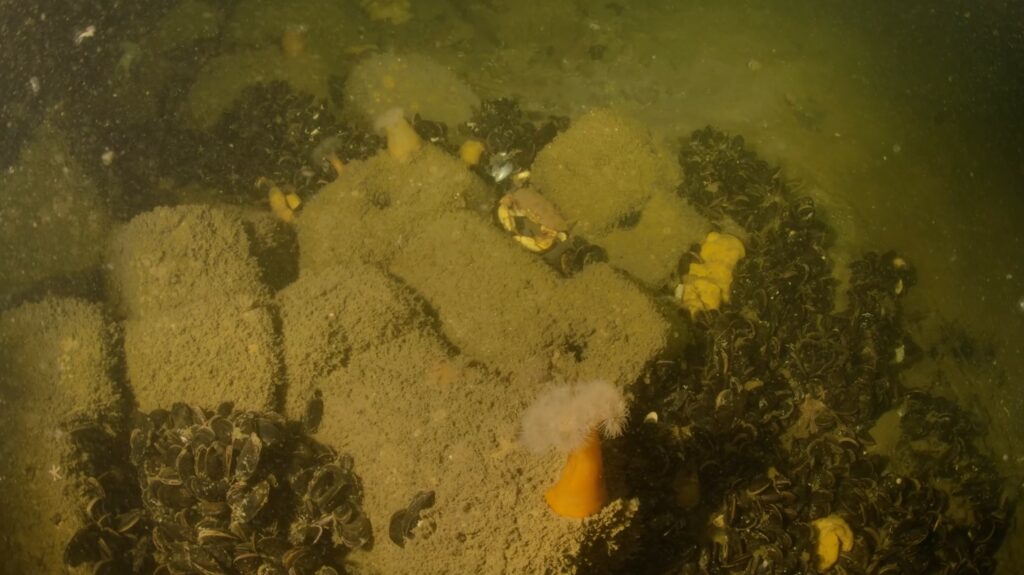
Preliminary results 18 months post-deployment reveal that the NID scour protection system enhances habitat potential for local species and improves the ecological function of the structure and its surroundings, resulting in increased overall biodiversity compared to control sites. The results from the ecological study, based on mapping and characterizing the sites, show that the design, materials, and habitat creation influence the types of communities that form in these areas – each with distinct ecological traits.  


The results demonstrate that the studied nature-inclusive scour protection system creates intentional habitats that different organisms use to settle and grow and show more biological accumulation compared to the rocks. The study shows that the interlocking design of ECOncrete scour protection units forms a complex system creating favorable habitats and niches for a wide range of organisms, especially for oysters and clams, supporting ecosystem development within the scour protection system.  


Data from multi-beam surveys with 13 months difference including all 2024 storm events, show no movement of the ECOncrete units. These data align with the results from 3D physical model tests conducted at the COB of Gent University on a movable (sandy) seabed in which the ECOncrete scour protection system around a monopile on top of a movable seabed was submitted to severe wave loads simulating real prototype conditions in the Atlantic and North Sea demonstrating great hydraulic stability. 


These results unlock new opportunities for the offshore supply chain by providing validation for an innovative, locally sourced NID scour protection solution, which acts as a full or complementary armor layer for offshore structures to reduce their ecological footprint on marine ecosystems, create opportunities for biodiversity enhancement, and benefit fisheries. 
Tips & Tricks

  • Proven structural NID solutions: Based on the findings from this project, ECOncrete recommends that NID innovators conduct 3D physical model tests to define the structural functionality of eco-engineered scour protection units, optimize the scour protection system, and meet applicable international standards and good practices.
  • Proven Biological enhancement creation: With this project’s results in mind, ECOncrete recommends that NID innovators conduct biological monitoring programs to assess the biological enhancement of the scour protection system.
  • Reduce the embodied carbon footprint of offshore structures: One of the main challenges for this project was to reduce its overall carbon footprint. As a solution, ECOncrete used low-carbon concrete mixes during the construction of the units to reduce the embodied carbon footprint of the scour protection infrastructure.
  • Prioritize local production and materials: It is also important to consider local content requirements of projects and enable local supply chains. For example, the units for this project were locally produced using standard concrete casting procedures, leveraging local workmanship. This reduces production time, shipping costs, and carbon emissions.
  • Design NID solution for multiple applications: ECOncrete’s scour protection solution can also be leveraged to optimize the design of  ‘rock berm’ for Cable Protection Systems.

Partners

Products used on this project

ECOncrete scour protection solution

ECOncrete

ECOncrete® scour protection solution is designed to optimize the scour and cable protection systems to create diverse habitats for marine life to settle, grow, and thrive. The nature-inclusive and interlocking design of the solution allows for biological enhancement and supports the creation of habitats for diverse marine fauna and flora species while providing the durability, seamless operational functionality (production and installation), and hydraulic stability required.

Scour and cable protection
Visit website

Let's talk

Would you like to get involved in nature enhancement or do you want to connect with our ecologists? Send us an e-mail.

toolbox@derijkenoordzee.nl