This project demonstrates that active kelp establishment under Dutch nearshore conditions is technically feasible while also identifying several important considerations for future restoration efforts. Through laboratory experiments, controlled flow testing and field deployments, the study generated new insights into the environmental conditions, substrates, and techniques that can support kelp restoration in the Dutch North Sea.
The results show that juvenile kelp can grow under relatively low-light conditions, indicating that light availability may not be as restrictive as previously assumed in some Dutch coastal environments. Growth was strongly influenced by starting density, with lower-density cultures generally producing larger sporophytes. This highlights the importance of optimising propagule density rather than simply maximising the amount of seed material used during restoration.
Substrate characteristics proved to be a key factor in restoration success. Rough and structurally complex surfaces, particularly wood, and stone-like MECAL nodes, supported substantially better attachment and growth than smooth materials such as glass, stainless steel, and flat plastics. These findings suggest that kelp restoration can be effectively integrated with rough mineral structures, including rock armour, scour protection, and other nature-inclusive marine infrastructure.
The direct-seeding approach also showed promising results. Kelp remained attached under controlled flow conditions, demonstrating that direct seeding can perform beyond static hatchery environments. Further optimisation is still required, particularly regarding propagule distribution, binder use, and performance under more exposed hydrodynamic conditions, but the results indicate strong potential for future upscaling.
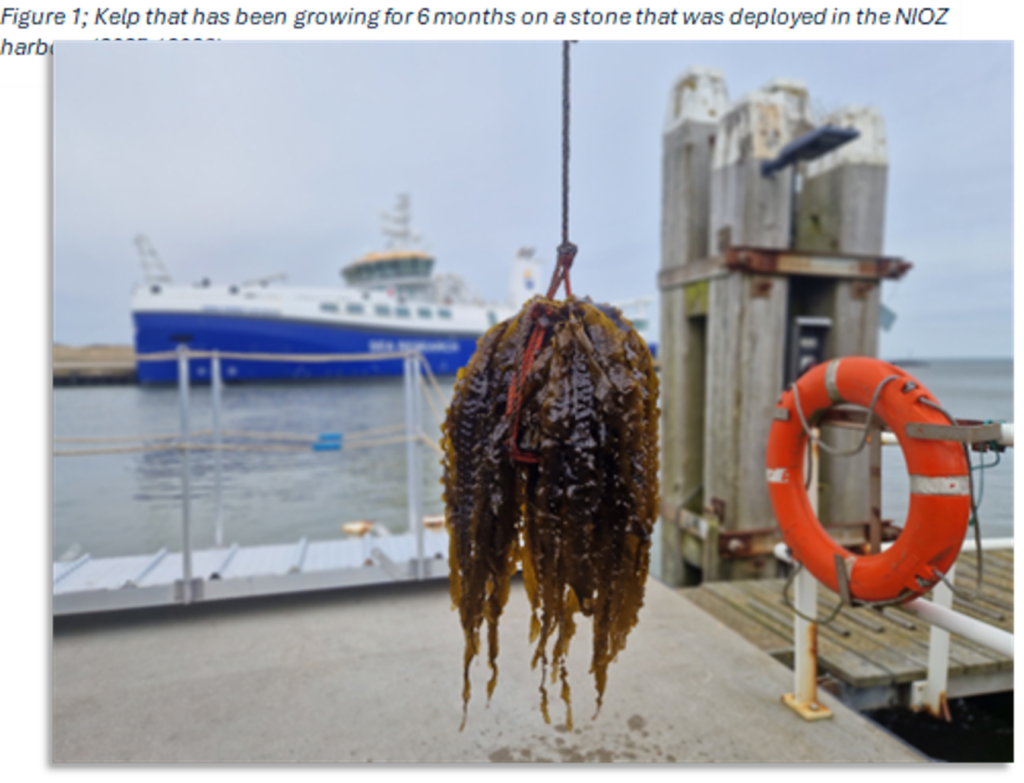
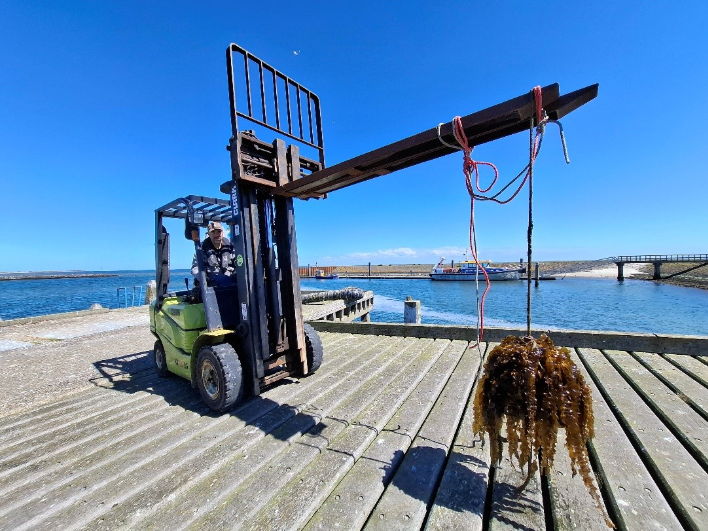
Field deployments provided an important proof of concept. Kelp successfully established and developed on artificial substrates at both Texel and Scheveningen, providing the first field validation within this project that hatchery-produced, directly seeded kelp can grow in Dutch coastal environments. In addition, retrieved substrates supported a range of associated marine organisms, demonstrating the potential for kelp-based restoration measures to contribute to habitat complexity and ecological value.
The study identified several promising areas for future restoration and demonstration projects. The Texel-Marsdiep region stands out due to successful pilot results, the availability of local genetic material and nearby research infrastructure. The Oosterschelde also shows potential because of its relatively favourable water clarity and historic occurrence of kelp populations, while Scheveningen offers opportunities as an accessible innovation and demonstration site. Offshore locations such as the Dogger Bank, Cleaver Bank, and Borkum Reef Grounds may also be suitable but require additional site-specific assessment before restoration measures can be implemented.
While the project successfully demonstrated kelp establishment and early growth, it does not yet demonstrate self-sustaining kelp restoration. Long-term survival, reproduction, natural recruitment and wider biodiversity benefits remain important next steps that should be addressed through larger, multi-year demonstration projects. This will be essential for determining the long-term ecological contribution of kelp restoration in the Dutch North Sea.