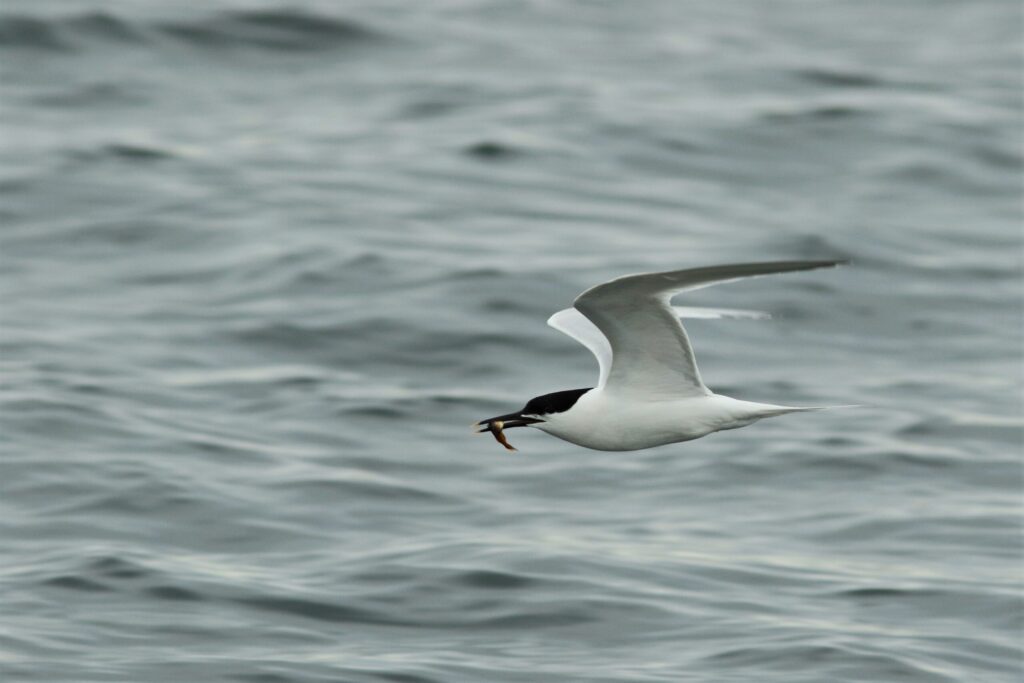
Grote stern met vis Waardenburg Ecology

Enhancing Forage Fish Populations for Seabirds

Forage fish species such as herring (Clupea harengus), sprat (Sprattus sprattus), and sandeel (Ammodytes spp.) are important food sources for seabirds in the North Sea. Stocks of these forage fish species have declined sharply since the 1970s. In this pilot, focus was placed on the spring-spawning herring (Clupea harengus), which is presumed to spawn in the Voordelta/Grevelingen area. The Voordelta hosts breeding colonies of sandwich tern (Thalasseus sandvicensis) and common tern (Sterna hirundo), which during the breeding season forage on prey fish such as juvenile herring, sprat, and sandeel. Spring-spawning herring deposit their eggs in shallow waters on structurally complex substrates such as seaweed or seagrass beds.

This project aimed to test the hypothesis that the installation of structurally complex spawning substrate can enhance the population of forage fish such as herring (Clupea harengus) and thereby improve food availability for fish-eating birds. To this end, structurally complex substrates were installed in April 2025 at two shallow locations in the Voordelta. The timing of deployment and monitoring was based on knowledge of spring-spawning herring in the Baltic Sea. A secondary objective of the project was to raise awareness of the importance of forage fish in the North Sea for seabirds, and of herring populations (and their differences) in particular.

Programme: Natuurversterking Noordzee (NN)
Image credit: Waardenburg Ecology

March – June 2025

Project dates

Voordelta

Location

Waardenburg Ecology, Nature regeneration North Sea, Next Generation EU

Project lead and partners

Spring-spawning herring (Clupea harengus)

Target species

Methods

Between March and June 2025, regular inspections of the installed substrates were carried out. The installed substrates consisted of a combination of natural and artificial structures designed to mimic structurally complex spawning habitats such as seaweed beds. Natural substrates included small spruce trees (Picea abies), while artificial substrates included plastic plant mats (approximately 0.3 × 0.5 m), artificial plants (approximately 0.3 m in length), metal frames with sisal or coconut fibres (approximately 0.3 × 0.5 m), and BESE mesh structures (approximately 0.6 m in length). These substrates were installed at two shallow locations in the Voordelta, at depths of approximately 2–8 metres.

Visual inspections were used to determine whether eggs were deposited on these substrates by herring (Clupea harengus) or other fish species. Monitoring was conducted at multiple intervals following installation, including several inspections in April, May, and June 2025, during which egg deposition, biofouling, and substrate condition were recorded.

Additionally, angling catches of adult herring at the Brouwersluis in the Grevelingen were monitored. Information on fish-eating bird species, such as sandwich tern (Thalasseus sandvicensis) and common tern (Sterna hirundo), was obtained from GPS tagging studies conducted in recent years.

The structure of the substrates, as well as the locations and timing of their deployment, were based on the life history of the spring-spawning herring (Clupea harengus) population, which occurs in the Baltic Sea, Denmark, and extends into the Wadden Sea.

Results

During the inspections of the substrates, no fish eggs were found; however, eggs of cuttlefish (Sepia officinalis) were observed. The reason why no herring (Clupea harengus) eggs were recorded remains unclear. There are, however, strong indications that spring-spawning herring also occur in the Delta area. It is possible that they spawn in seaweed beds present in the Grevelingen.

A recommendation is to monitor herring schools in the Voordelta and Grevelingen during spring and to inspect seaweed beds to determine whether the availability of suitable spawning habitat may be a limiting factor. The report further provides a brief overview of the importance of forage fish in the North Sea for seabirds.


Download full report:
Strengthening forage fish populations to support food availability for seabirds – Pilot spawning substrate herring Voordelta (2025)

Tips & Tricks

  • For both locations in the Voordelta, structures were used for which a Water Act permit had previously been issued. This made it possible to start the pilot quickly without the need for a time-consuming permitting process.
  • Timely deployment of substrates is critical; installation later in the season may result in missing the herring (Clupea harengus) spawning period.
  • Natural spawning habitats such as seaweed beds may be preferred over artificial substrates and should be considered when selecting locations.
  • Presence of adult herring does not guarantee local spawning on installed substrates; identifying actual spawning sites beforehand is important.
  • Secure installation and site selection are essential, as deployed structures may be lost due to human activities.


Products used on this project

Reef Ball

Reef Innovations

A Reef Ball is a designed artificial reef module which mimics the structure and function of a natural reef. It is made with special concrete additives for compatibility with marine environments and to enhance colonization by organisms.

Stand-alone structures
Visit website

Let's talk

Would you like to get involved in nature enhancement or do you want to connect with our ecologists? Send us an e-mail.

toolbox@derijkenoordzee.nl