ECOMUG

Offshore infrastructure such as wind turbines, platforms, and other marine structures can provide opportunities for nature enhancement by creating additional habitat for marine species. The ECOMUG project explores how existing offshore infrastructure can be used to support habitat restoration and biodiversity recovery without requiring new constructions at sea.


The project focuses on the development of modular and reversible habitat units that can be attached to existing offshore structures. These habitat units are designed to increase structural complexity and provide refuge, feeding, and nursery habitat for a wide range of marine organisms. By making use of existing infrastructure, the concept aims to create ecological benefits without occupying additional seabed or interfering with activities at the water surface.

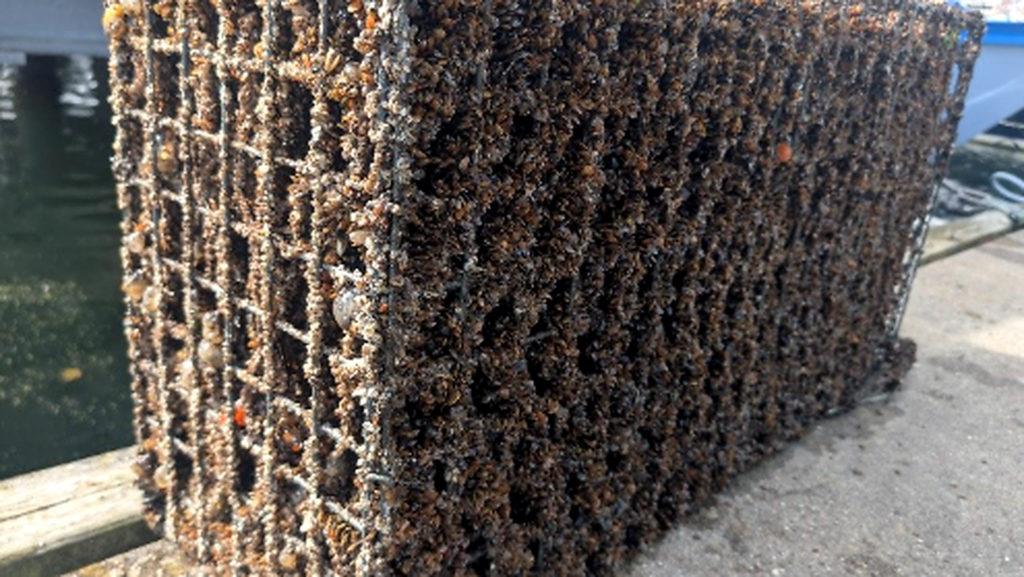
Two habitat concepts were developed and tested: modular gabions filled with biodegradable materials and oyster shells, and stacked concrete-biochar plates. Both designs create cavities and sheltered spaces that can be colonised by marine species. In addition, ECOMUG developed an innovative magnetic attachment system that allows habitat units to be installed, inspected, relocated, and removed without drilling, welding or diver operations.

A nearshore field test in the Kiel Fjord demonstrated that both habitat concepts remained structurally stable and were colonised by a variety of marine organisms, including mussels, algae, crustaceans and fish. The modular gabion design showed particular potential due to its flexibility, lightweight construction, and ability to incorporate different substrates for specific restoration objectives.

The next step is to validate the concept under representative North Sea conditions and investigate its potential to support the recovery of species such as the European oyster (Ostrea edulis). The project aims to demonstrate whether existing offshore infrastructure can become a practical platform for habitat restoration while maintaining technical safety, operational feasibility, and measurable ecological benefits.

Program: Nature Regeneration North Sea (NN)
November 2025 – Octobter 2026

Project dates

Kiel, Germany

Location

F&E GmbH

Project lead and partners

Hardsubstrate habitats, juveniles of endangered fish species

Target species

Methods

The ECOMUG project developed and tested two modular Nature-Inclusive Design (NID) habitat concepts aimed at enhancing the ecological value of existing marine infrastructure. The first concept consisted of modular gabions filled with biodegradable BESE Type 2 material and oyster shells, while the second applied stacked concrete-biochar plates. Both designs were created to increase structural complexity and provide refuge, feeding, and nursery habitat for marine organisms. The modular gabion concept was designed to be highly adaptable, allowing different substrates to be incorporated, exchanged or rearranged depending on restoration objectives and local site conditions.


The habitat units make use of natural and nature-based materials and ecological processes. Oyster shells were included as a potential settlement substrate, while the biodegradable BESE material created additional habitat complexity through a network of cavities and sheltered spaces. The approach was intended to support colonisation by marine organisms and explore the potential of different substrate types for species-specific restoration goals, including future applications targeting the European oyster (Ostrea edulis).


As part of the project, a reversible magnetic attachment system was developed and tested to attach habitat units to steel structures without drilling, welding, or diver operations. The system was designed to enable remote installation, retrieval, and relocation while avoiding permanent modification of the supporting infrastructure.


Prototype habitat units were installed in the Kiel Fjord and monitored between January and September 2026. Monitoring focused on structural integrity, environmental conditions, biological colonisation, and the use of habitats by mobile fauna. Interval cameras and underwater observations using drop-in cameras were used to document habitat development and species presence, while an automated image-analysis workflow was developed to support ecological assessment. The project followed an iterative development approach, combining prototype design, field testing, and evaluation to identify opportunities for further optimisation and future offshore application under representative North Sea conditions.

Results

The ECOMUG project demonstrates that modular habitat units can be successfully integrated with existing marine infrastructure to create additional habitat complexity and support marine biodiversity. Both habitat concepts remained structurally stable throughout the January to September testing period and showed clear biological colonisation, confirming the technical feasibility of the approach under nearshore conditions.


The modular gabion habitat proved to be the most flexible and ecologically diverse of the two concepts. Its network of cavities and sheltered spaces was colonised by mussels, algae, sea stars, crabs, and shrimp, while several fish species, including European eel (Anguilla anguilla), were observed using the habitat. The ability to incorporate and exchange different substrate materials also demonstrated the potential to adapt the design to specific restoration objectives and local environmental conditions.


The stacked concrete-biochar plate design also remained stable and attracted a range of marine organisms, including mussels, barnacles, algae, fish, and crustaceans. While the structure provided valuable habitat through larger cavities and sheltering spaces, it supported a less diverse community of mobile fauna and offered less flexibility than the gabion concept. Nevertheless, the results show that both designs have the potential to enhance the ecological value of offshore structures.


The use of oyster shells as a settlement substrate did not result in increased mussel settlement under the brackish conditions of the Kiel Fjord. However, this outcome is considered site-specific and does not rule out the potential of oyster shells to support restoration objectives in higher-salinity environments. Further testing under representative North Sea conditions is therefore recommended, particularly to assess opportunities for European oyster (Ostrea edulis) recruitment and settlement.


An important outcome of the project was the successful development of a reversible magnetic attachment system. The system demonstrated that habitat units can be attached to steel structures without drilling, welding or diver operations, while also allowing remote installation, retrieval, replacement and relocation. This provides a practical solution for offshore environments where safety requirements and operational constraints increasingly limit the use of divers.


The project also demonstrated the value of integrating automated ecological monitoring into nature-inclusive designs. An image-analysis workflow was developed to assess biological colonisation and habitat performance, creating opportunities for more efficient monitoring, and long-term evaluation of ecological outcomes.


Overall, the results show that modular and reversible habitat units can provide a scalable and adaptable approach for enhancing biodiversity on existing marine infrastructure. The gabion concept emerged as the most promising design due to its flexibility, lightweight construction and ability to support a diverse range of species. The next step is to validate the concept under representative North Sea conditions and further investigate offshore performance, oyster recruitment potential and automated monitoring technologies.

Tips & Tricks


  • Design habitat measures to be modular and adaptable.
    Modular habitat units can be adjusted to different ecological objectives, target species and environmental conditions by incorporating or exchanging different substrate materials. This flexibility increases the potential for application across a wide range of offshore locations.
  • Prioritise structural complexity.
    Habitats that provide a variety of cavities, shelter opportunities and interstitial spaces are more likely to support diverse biological communities. In this project, the gabion concept attracted a broader range of marine organisms than the more uniform plate design.
  • Consider installation and maintenance from the start.
    Offshore operations are costly, weather-dependent and subject to strict safety requirements. Designing habitat units that are lightweight, easy to handle and suitable for remote installation can significantly improve practical feasibility.
  • Build reversibility into the design.
    Nature-inclusive measures do not necessarily need to be permanent. Reversible attachment systems can allow habitat units to be inspected, replaced, relocated or removed as ecological objectives, infrastructure use or environmental conditions change.
  • Integrate monitoring from the beginning.
    Monitoring should be considered an integral part of habitat design rather than an afterthought. Combining ecological monitoring with automated data collection and analysis can improve understanding of ecological performance and support adaptive management.
  • Engage stakeholders early in the design process.
    Successful implementation depends on aligning ecological ambitions with operational and technical requirements. Co-design with infrastructure owners and other offshore users can help ensure that habitat measures are practical, acceptable and scalable.
  • Validate concepts under representative offshore conditions.
    Nearshore trials are valuable for testing feasibility, but offshore environments present additional challenges related to waves, currents, weather and logistics. Demonstration projects under North Sea conditions are an important step before large-scale implementation.
  • Plan for restoration objectives at site level.
    The suitability of habitat materials and substrates can vary between locations. Selecting materials based on target species, local environmental conditions and historical habitat characteristics can improve the effectiveness of nature enhancement measures.


Let's talk

Would you like to know more about this project or get involved? Send an email to the project lead.

eva.strothotte@fe-kiel.de