Droppable Oyster Structures in Borssele I/II

Van Oord has been working to reintroduce European flat oysters to the Dutch North Sea using liftable broodstock structures. These structures, containing reproductive adult oysters, act as local larvae pumps to support reef restoration. However, the structures’ weight of approximately 3,000 kg requires large vessels and cranes for deployment, making them costly and limiting scalability. To expand restoration efforts, a more cost-effective and easier-to-install solution is needed.

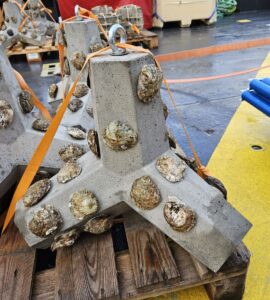
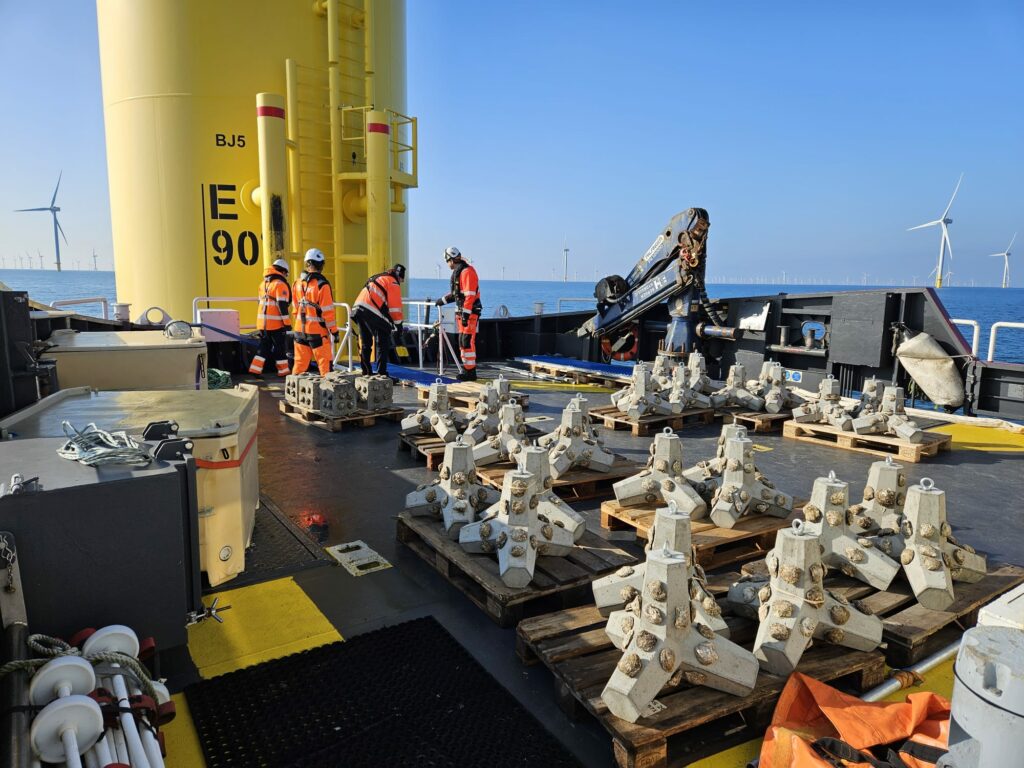
To overcome these challenges, Van Oord and TU Delft developed Droppable Oyster Structures (DOS), compact and cost-effective units weighing up to 50 kg, which can be manually deployed from small vessels. In partnership with Ørsted and the Ocean Health initiative, 60 concrete tetrapods and 10 bio-based cubes from GEOWALL were deployed at the Borssele I/II wind farm.

If results show success in fostering oyster reef formation, the DOS can be seamlessly integrated into existing wind farms as part of routine maintenance activities. This approach provides a simple, effective, and cost-efficient method for restoring flat oyster reefs within wind farm environments.

2024-2032

Project dates

Borssele I/II OWF (NL)

Location

Van Oord & Ørsted, Waardenburg Ecology, GeoWall, GoOcean

Project lead and partners

European flat oyster (Ostrea edulis)

Target species

Methods

At the start of the study by Van Oord and TU Delft, various design concepts were evaluated to determine their suitability for the Dutch North Sea. The assessment considered environmental and hydraulic conditions, along with specific design criteria and requirements. These criteria included factors such as water flow, available space, protection against predation, oyster settlement potential, durability, stability, positioning, structural integrity, ease of installation, manufacturing processes, and transportation logistics.


Ten designs were evaluated and tested to address the three key phases of the structures’ lifecycle: the fall from the vessel during deployment, landing on the scour protection, and maintaining stability on the scour protection over a 30-year lifespan. The study combined predictive behavioural calculations with physical modelling, including tests conducted in the wave flume at the hydraulic engineering laboratory of TU Delft’s Civil Engineering faculty.


Results of the study identified the tetrapod design as the top performer across the evaluated criteria. Van Oord and Ørsted sought to test an alternative to concrete in the project. They selected GEOWALL, a material with concrete-like properties made from dredged sediment and natural binders. Since this material can only be molded into blocks, the reference block was chosen as the second structure for inclusion in the project. It also demonstrated promising results during the study.


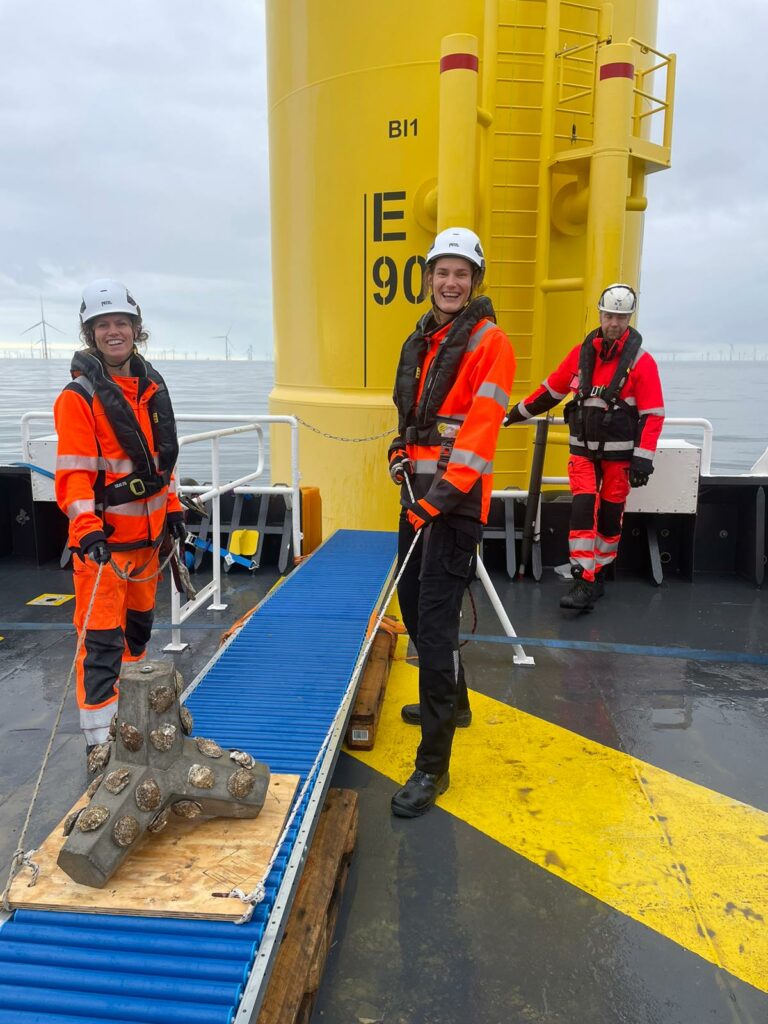
Deploying the Droppable Oyster Structures (DOS) requires a simple vessel, such as a Crew Transfer Vessel. These vessels use roller conveyors to guide the structures to the vessel’s edge, where they are released into the water. Monitoring will be conducted through the collection and analysis of ROV video footage.

The structures will remain part of the scour protection and be removed only if the scour protection is decommissioned.

Results

The deployment method has significantly improved the ease of installing oyster broodstock. The footage of the first monitoring campaign, collected 6 weeks after deployment, already gives a glimpse into the effectiveness of the structures; all structures we found landed on the scour protection as expected, and are in good condition after the fall. Monitoring is planned for year 1, 3 and 8 to assess the effectivity of this method to kick-start flat oyster reef formation in the area.


The method works well in calm weather conditions, but performance in rough weather conditions is currently unknown. No decommissioning is required for the structures.

Tips and Tricks

  • Concrete structures perform well in terms of strength and resilience. Finding a fully bio-based alternative material with similar characteristics is a challenge. The recipe of the material used in this project may be optimized.
  • To drastically cut costs, deployment activities are to be combined with regular maintenance schedules in wind farms, when a vessel arrives at a monopile to drop of technicians, a few structures can easily be deployed at the same time.
  • When using a smaller vessel for deployment, calm weather conditions are very beneficial and enhance ease of implementation.
  • Gluing of adult oysters to structures is relatively time consuming.
  • Glue needs to be fully dried before deployment, otherwise oysters might come off.
Want to learn more?

Watch the DOS in action

Learn more about the droppable oyster structures and the pilot project in offshore wind farm Borssele I/II here:


Partners

Products used on this project

Droppable Oyster Structures (DOS)

Van Oord

The innovative Droppable Oyster Structures (DOS) offer a cost effective method for oyster reef restoration, and are easy to install. The DOS introduce reproductive adult oysters to restoration locations, producing larvae that settle upon nearby hard substrates and develop into flourishing oyster reefs.

Stand-alone structures Scour and cable protection
Visit website

Let's talk

Would you like to get involved in nature enhancement or do you want to connect with our ecologists? Send us an e-mail.

Nienke.Oostenbrink@vanoord.com